
Can a Therapist Diagnose?
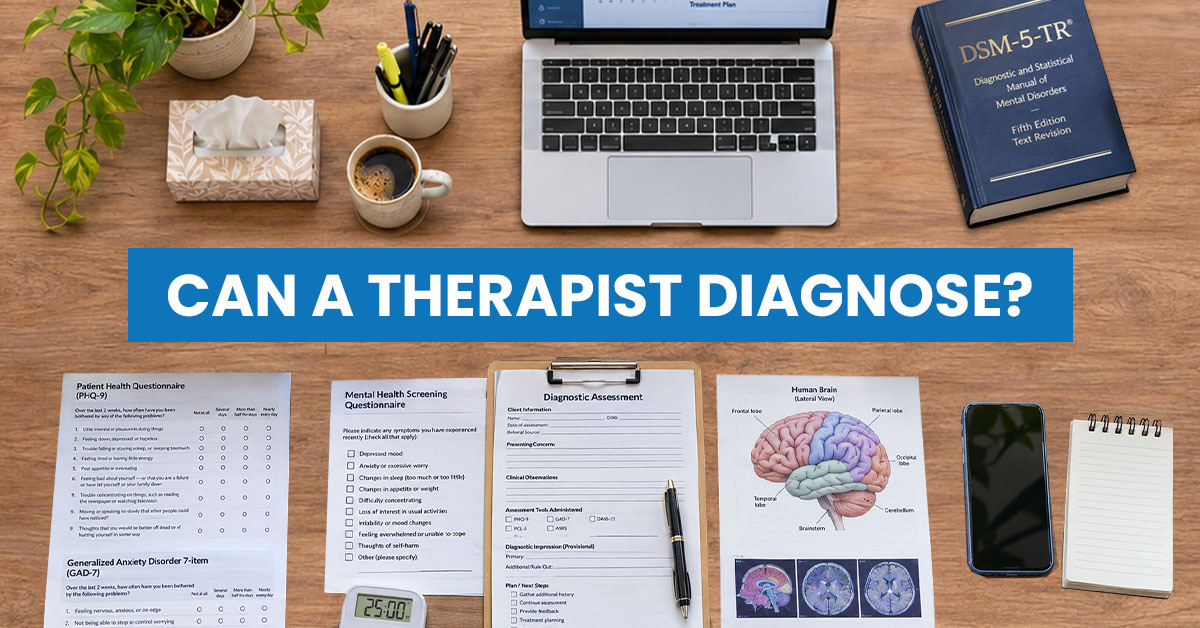
Yes. Most licensed therapists can diagnose mental health conditions in the United States. This includes LCSWs, LMFTs, LMHCs, and LPCs, who are authorized to diagnose and treat common conditions such as anxiety, depression, PTSD, and adjustment disorders. However, conditions requiring specialized medical evaluations (like ADHD or Autism) are typically diagnosed by psychologists or psychiatrists.
In short, whether a licensed therapist can diagnose depends on the condition, their license type, and the state in which they practice.
In this article, you will find who can diagnose, which conditions a therapist can and cannot evaluate, how the process actually works, and what a diagnosis means for your treatment going forward.
Key Takeaways
- Most licensed therapists, including LCSWs, LMFTs, LMHCs, and LPCs, can diagnose common mental health conditions in most U.S. states.
- Therapists use the DSM-5-TR, the Diagnostic and Statistical Manual of Mental Disorders, to evaluate and classify conditions.
- Diagnosis authority varies by license type and state. Some states restrict certain credentials from diagnosing independently.
- Complex conditions like ADHD and autism typically require specialized testing beyond what most therapists provide.
- A therapist can diagnose you, but cannot prescribe medication. That requires a psychiatrist, physician, or other licensed prescribing provider.
- You do not need a diagnosis to start therapy. Many people begin without one and receive one as part of the treatment process.
- Psychologists with a PhD or PsyD have advanced training in psychological testing and can diagnose the full spectrum of mental health conditions, including complex conditions like ADHD and autism that require formal testing.
Summary: Can Therapists Diagnose?
| Provider | Can Diagnose? | Conditions Typically Diagnosed | Can Prescribe? |
|---|---|---|---|
| LCSW | Yes, in most states | Anxiety, depression, PTSD, acute stress disorder, adjustment disorders | No |
| LMFT | Yes, in most states | Depression, anxiety, marital and family conflict, individual and child-parent problems | No |
| LMHC / LPC | Yes, in most states | Anxiety, depression, PTSD, mood disorders | No |
| Psychologist (PhD/PsyD) | Yes | Full spectrum, including ADHD and autism | No, except in 8 states |
| Psychiatrist (MD/DO) | Yes | Full spectrum, including complex and treatment-resistant conditions | Yes |
| Primary Care Physician (MD/DO) | Yes, common conditions | Depression, anxiety, sleep disorders | Yes |
| Psychiatric Nurse Practitioner (PMHNP) | Yes | Full psychiatric spectrum | Yes, in all 50 states and D.C., with state-specific independence and supervision requirements |
| Physician Assistant (PA) | Yes, within scope | Common mental health conditions | Yes, with state-specific requirements |
For a full explanation of which providers can prescribe mental health medication and what that means for your care, see Can a Therapist Prescribe Medication?.
Can Therapists Diagnose?
Yes. Licensed therapists can diagnose mental health conditions in the United States, provided they hold the appropriate credential and practice in a state that authorizes diagnosis within their scope of practice. This applies to the most common therapy credentials: Licensed Clinical Social Workers, Licensed Mental Health Counselors, Licensed Professional Counselors, and Licensed Marriage and Family Therapists.
Diagnosis in therapy is an important part of understanding your mental health and creating the right treatment plan. One of a therapist’s primary responsibilities is to evaluate your symptoms, explore your personal history, and identify whether your experiences align with an established mental health condition.
Therapists use guidelines from the DSM-5-TR (Diagnostic and Statistical Manual of Mental Disorders, Fifth Edition, Text Revision), the standard reference used by mental health professionals, to make accurate and informed diagnoses. This process helps ensure you receive care that is tailored to your needs, goals, and overall well-being. That manual is the primary diagnostic reference used by licensed mental health professionals in the United States, and its criteria are used alongside ICD-10-CM codes required for insurance billing.
Some conditions, particularly neurodevelopmental disorders like ADHD and autism, and conditions with significant biological components, require more specialized evaluation than a standard clinical interview provides. In those cases, a therapist will typically refer you to a psychologist or psychiatrist for comprehensive testing, and coordinate that process as part of your care.
Can Therapists Diagnose Mental Health Conditions?
Yes. Licensed therapists are trained and authorized to diagnose a wide range of mental health conditions, from anxiety and depression to trauma-related disorders and mood conditions. What they diagnose, and how, depends on their credential, their clinical training, and the state they practice in.
The diagnostic process in therapy is thoughtful, structured, and clinically guided, therapists take time to understand your symptoms, your history, and how your mental health is affecting your daily life.
This may include clinical interviews, intake assessments, mental status exams, and professional clinical judgment.
Therapists may also use screening tools, such as the PHQ-9 for depression or the GAD-7 for anxiety, to better understand symptom severity.
These are helpful, but they do not replace a full clinical evaluation. A diagnosis is based on the complete picture of your health, using DSM-5-TR criteria and the ICD-10-CM codes often required for insurance billing.
One distinction worth understanding: therapists diagnose mental health conditions. They do not diagnose medical conditions, neurological disorders, or physical health problems. If your symptoms have a potential medical component, a referral to a primary care physician or psychiatrist is the appropriate next step.
At OneMed Clinic, our therapy team and primary care team work within the same integrated practice, so that coordination happens without you having to manage it separately.
Can My Therapist Diagnose Me?
Yes. Your therapist can diagnose you if they hold a license that includes diagnostic authority in your state. In most U.S. states, LCSWs, LMFTs, LMHCs, and LPCs are all authorized to diagnose mental health conditions as part of their clinical practice, within their license scope and according to state law.
For many people, it may come as a surprise that a therapist can provide a formal mental health diagnosis. In most cases, you do not need to see a psychiatrist or psychologist solely to receive a diagnosis.
Licensed therapists are trained to evaluate symptoms, review personal and medical history, and determine whether those symptoms meet established diagnostic criteria.
Using the DSM-5-TR as a guide, they can assign a formal diagnosis when appropriate and develop a treatment plan tailored to your needs.
It also means that in many cases, your therapist has already diagnosed you, even if they have not said so explicitly. When insurance is involved, therapists are typically required to assign a diagnosis code on the very first billing claim to establish medical necessity. If you are unsure whether you have been diagnosed, you have every right to ask your therapist directly. A good therapist will tell you what diagnosis, if any, is in your record and how it is informing your treatment plan.
What Level of Therapist Can Diagnose?
Licensed mental health professionals who can diagnose mental health conditions may include psychologists, clinical social workers, licensed mental health counselors, licensed professional counselors, marriage and family therapists, psychiatrists, and psychiatric nurse practitioners. The key factor is licensure, not just job title. Exact diagnostic authority depends on the provider’s license, training, and state law.
Below are several levels of licensed mental health professionals who hold diagnostic authority in the United States, each with different levels of training and scope.
Can Licensed Therapists (LCSW, LMFT, LMHC, LPC) Diagnose?
Licensed Clinical Social Workers, Licensed Marriage and Family Therapists, Licensed Mental Health Counselors, and Licensed Professional Counselors are all master’s-level clinicians who are authorized to diagnose mental health conditions in most U.S. states. They use clinical interviews, intake assessments, mental status exams, and validated screening tools to evaluate symptoms and assign diagnoses based on DSM-5-TR criteria.
Their diagnostic scope covers the most common mental health conditions:
- Anxiety disorders
- Depressive disorders
- Trauma and stressor-related disorders
- Adjustment disorders
- Mood disorders.
State regulations vary, and a small number of states place restrictions on independent diagnosis for certain license types. If you are unsure whether your therapist’s license includes diagnostic authority in your state, you can ask them directly or check with your state’s licensing board.
While all four licenses share diagnostic authority for common conditions, their underlying therapeutic frameworks and clinical approaches differ in meaningful ways. For a full breakdown of how each credential approaches treatment differently, see Types of Therapists: Who Does What?
Clinical Insight from OneMed Clinic: A therapist’s clinical assessment covers most common mental health conditions well. There are three situations where we refer out for more intensive evaluation: complex neurodevelopmental conditions like autism spectrum disorder or ADHD, which require specialized psychometric testing; significant cognitive changes that may involve neurological factors such as traumatic brain injury or dementia; and cases where a physical medical condition may be mimicking psychiatric symptoms, such as a thyroid disorder driving severe anxiety. In those cases, the right next step is a specialist evaluation, not more talk therapy. At OneMed, that referral happens as part of your care, not as a separate process you have to navigate alone.
Can Psychologists (PhD and PsyD) Diagnose?
Psychologists hold doctoral-level degrees and are among the most comprehensively trained diagnosticians in the mental health field. In addition to clinical interviews and screening tools, psychologists are trained to administer and interpret formal psychological and neuropsychological testing, which makes them particularly well suited for diagnosing complex or nuanced conditions.
Some conditions require a more detailed evaluation to fully understand what is going on. ADHD, autism spectrum disorder, learning disabilities, and personality disorders can involve patterns that are not always clear through a standard clinical interview alone.
A psychologist’s comprehensive evaluation can provide a deeper level of diagnostic clarity; this includes formal testing, structured assessments, and a closer look at how symptoms are affecting your learning, relationships, work, and daily life.
If your therapist believes this type of evaluation would be helpful, a referral to a psychologist is a common and appropriate next step.
Can Psychiatrists Diagnose?
Psychiatrists are physicians, either MDs or DOs, who specialize in mental health. They can diagnose the full spectrum of mental health conditions and are the only mental health professionals who can also prescribe and manage psychiatric medications. Their diagnostic process includes clinical interviews, mental status examinations, and medical evaluation, which allows them to assess whether physical health factors are contributing to psychiatric symptoms. For a full comparison of what psychiatrists and therapists each do, see Psychiatrist vs. Therapist: What’s the Difference and Who Do You Need?.
Can a Marriage and Family Therapist Diagnose?
Yes. A Licensed Marriage and Family Therapist can diagnose mental health conditions in most U.S. states. LMFTs are master’s-level clinicians trained to assess and treat a wide range of mental health conditions in individuals, couples, and families, and their license includes diagnostic authority in the majority of states.
The American Association for Marriage and Family Therapy confirms that marriage and family therapists are trained to diagnose and treat mental and emotional disorders within the context of relationships and family systems. In practice, LMFTs commonly diagnose depression, anxiety disorders, adjustment disorders, and relational and behavioral conditions affecting individuals and families.
Take into account that in some states, LMFTs may have certain limits around independent diagnosis or may need additional supervision for specific diagnostic functions.
If you are working with an LMFT and have questions about their diagnostic authority, ask them directly. A qualified therapist should be able to explain what falls within their scope, what services they can provide, and when a referral may be needed.
Do Therapists Diagnose You or Psychiatrists?
Both therapists and psychiatrists can diagnose mental health conditions. Therapists diagnose through clinical interviews, intake assessments, and screening tools. Psychiatrists diagnose through the same methods plus medical evaluation and are the only ones who can also prescribe medication.
A therapist diagnoses through clinical interviews, intake assessments, mental status exams, and screening tools, focusing on psychological and behavioral patterns.
On the other hand, a psychiatrist diagnoses through clinical interviews, medical evaluation, and mental status exams, with the added ability to assess biological and physiological contributors to psychiatric symptoms and to prescribe medication when indicated.
For most common mental health conditions, a therapist’s diagnostic assessment is sufficient. For complex conditions, treatment-resistant presentations, or situations where medication is being considered, a psychiatrist’s evaluation adds a medical dimension that a therapist’s assessment alone cannot provide.
At OneMed Clinic, our therapy team and psychiatry team work within the same integrated practice. If your care requires both a therapeutic and a psychiatric evaluation, that coordination happens internally without you having to manage it across separate providers. If you are ready to get a clear picture of what you are dealing with, book an appointment with OneMed Clinic and we will make sure the right provider evaluates you from the start.
What Can a Therapist Diagnose You With?
Therapists can diagnose mental health conditions that fall within their license, training, and state scope of practice. Common diagnoses may include anxiety disorders, depression, PTSD, OCD, bipolar disorder, eating disorders, substance use disorders, adjustment disorders, and relationship or family-related concerns. Some conditions may require evaluation by a psychologist, psychiatrist, or other specialist.
The sections below cover the most common conditions that they diagnose.
What Conditions Can Therapists Diagnose?
The table below covers the conditions most commonly diagnosed within a therapist’s standard scope of practice.
| Condition | Can a Therapist Diagnose? | Specialist Referral Typically Needed? |
|---|---|---|
| Major Depressive Disorder | Yes | No, unless treatment-resistant or medication evaluation needed |
| Generalized Anxiety Disorder | Yes | No, unless symptoms have a medical component |
| PTSD and Acute Stress Disorder | Yes | Trauma-trained therapist recommended for treatment |
| Adjustment Disorders | Yes | No |
| Social Anxiety Disorder | Yes | No, unless symptoms are severe or medication is being considered |
| Panic Disorder | Yes | No, unless medical causes need to be ruled out |
| Bipolar Disorder | Yes, with clinical caution | Often yes, psychiatrist evaluation recommended |
| OCD | Yes | ERP-trained therapist recommended from the start of treatment |
| Personality Disorders | Yes, with clinical caution | Often yes, doctoral-level evaluation recommended |
| ADHD | Limited | Yes, psychologist evaluation recommended |
| Autism Spectrum Disorder | Limited | Yes, specialized psychometric testing required |
Diagnostic authority for licensed therapists varies by state and license type. For specific information about your state’s scope-of-practice rules, consult your state’s licensing board.
Can a Therapist Diagnose Depression?
Yes. A licensed therapist can diagnose major depressive disorder and other depressive conditions. Depression is one of the most commonly diagnosed conditions in outpatient therapy settings, and most licensed therapists are well trained to evaluate it using clinical interviews, mental status exams, and severity screening tools like the PHQ-9, which measures symptom severity rather than serving as a standalone diagnostic instrument.
Depression is more than feeling sad or having a difficult week. Mental health professionals look for a pattern of symptoms that affect how a person thinks, feels and functions over time.
During an evaluation, a therapist may ask about ongoing feelings of sadness, loss of interest in activities you once enjoyed, changes in sleep or appetite, low energy, difficulty concentrating, and feelings of hopelessness or low self-worth. These symptoms are carefully reviewed using established DSM-5-TR criteria to discover whether they meet the requirements for a depressive disorder.
A thorough assessment also looks beyond the symptoms themselves. Therapists consider whether another mental health condition, a medical issue, medication, or substance use could be contributing to how you are feeling.
Can a Therapist Diagnose Anxiety?
Yes. A licensed therapist can diagnose anxiety disorders, including generalized anxiety disorder, social anxiety disorder, panic disorder, and specific phobias. Anxiety disorders are among the most frequently diagnosed conditions in therapy, and licensed therapists are trained to differentiate between anxiety disorder subtypes using clinical interviews and DSM-5-TR criteria.
Screening tools like the GAD-7 are commonly used to measure anxiety severity and track symptom changes over time, but diagnosis is based on the full clinical evaluation, not the screening score alone. If anxiety symptoms appear to have a medical component, such as cardiac or thyroid involvement, a referral to a primary care physician or psychiatrist is the appropriate next step.
Can a Therapist Diagnose Bipolar?
Yes, a licensed therapist can diagnose bipolar disorder, but this diagnosis warrants particular clinical care. Bipolar I disorder requires at least one manic episode, while Bipolar II requires at least one hypomanic episode and at least one major depressive episode. Both types can present with significant mood complexity, and their symptoms can overlap with major depression, ADHD, borderline personality disorder, and other conditions, making accurate diagnosis particularly challenging. Misdiagnosis is a recognized clinical risk, particularly when a patient presents during a depressive episode without a clear manic history.
Because of this, a therapist can diagnose bipolar disorder when it falls within their scope, but a psychiatric evaluation is often an important next step. It can help confirm the diagnosis. It can help confirm the diagnosis. It can rule out medical factors. And it can determine whether a mood‑stabilizing medication may be helpful.
At OneMed Clinic, when our therapists identify a potential bipolar presentation, that conversation with our psychiatry team happens internally, quickly, and without the patient having to start over elsewhere.
Can Therapists Diagnose Personality Disorders?
Yes. Licensed therapists can diagnose personality disorders using DSM-5-TR criteria, but these diagnoses require particular clinical caution. Personality disorders, including borderline personality disorder, narcissistic personality disorder, and others, involve pervasive, long-standing patterns of thinking, feeling, and behaving that can be difficult to distinguish from other conditions, especially early in treatment.
A thorough personality disorder diagnosis typically requires multiple sessions of careful observation, a detailed personal and developmental history, and in many cases a doctoral-level evaluation to rule out overlapping conditions. If you suspect you may have a personality disorder, seeking an evaluation from a clinical psychologist or psychiatrist is strongly recommended. They have specialized training in complex diagnostic assessment that goes beyond what a standard clinical interview provides. At OneMed Clinic, our psychiatry team can conduct that evaluation and coordinate your care from there.
Can a Therapist Diagnose You With a Mental Illness
Yes. A licensed therapist can diagnose you with a mental illness. In clinical and legal terms, mental illness refers to conditions that meet the diagnostic criteria established in the DSM-5-TR, and licensed therapists are authorized to evaluate and diagnose those conditions within their scope of practice.
Mental illness is a broad term that includes many diagnosable conditions. This can include:
- Depression
- Anxiety disorders
- Trauma-related disorders
- Bipolar disorders
- Obsessive-compulsive disorders
- Personality disorders
And other mental health concerns.
When a licensed therapist provides a diagnosis within their scope, that diagnosis can support treatment planning, insurance billing, and requests for workplace or academic accommodations. It gives patients and care teams a clear starting point for understanding symptoms and choosing the right next steps.
One important distinction: receiving a mental illness diagnosis from a therapist does not automatically mean you need medication. Many mental health conditions are treated effectively with therapy alone. If medication is part of your treatment picture, your therapist will coordinate a referral to a prescribing provider. For a full explanation of what that process looks like, see Can a Therapist Prescribe Medication?.
Can a Therapist Diagnose ADHD?
A therapist may be able to diagnose ADHD if their license, training, and state scope of practice allow them to diagnose mental or behavioral health conditions. A therapist can also identify symptoms consistent with ADHD and provide a clinical impression. Because ADHD can overlap with anxiety, depression, sleep problems, substance use, and learning disorders, a full evaluation may involve a psychologist, psychiatrist, physician, nurse practitioner, or ADHD-trained clinician.
How Does a Therapist Know If You Have ADHD?
A therapist identifies potential ADHD by evaluating symptoms across two core domains established in the DSM-5-TR: inattention and hyperactivity or impulsivity. They will ask about the onset, duration, and severity of symptoms, assess whether they are present across multiple settings such as work, school, and relationships, and consider whether another condition better explains the presentation.
When ADHD may be part of the picture, therapists often use screening tools to better understand what you are experiencing. Tools like the Adult ADHD Self-Report Scale or the Conners Rating Scales can show how symptoms are affecting focus, behavior, and daily life.
These tools are only one part of the process. They do not confirm ADHD on their own.
If ADHD seems likely after a clinical evaluation and screening, the next step is usually a complete assessment with a psychologist or psychiatrist. This gives a clearer picture of attention, behavior, and thinking patterns, so the diagnosis and care plan are as accurate as possible.
At OneMed Clinic, that referral happens within our integrated practice, so the process moves efficiently without you navigating it alone.
“I was diagnosed with ADHD at 35, and struggled for years to find a good doctor to help me manage my condition. When I moved to FL couple years ago, I had simply give up on the search. I tried to get any clinic that would have a Telehealth and could prescribe the medication I was taking. I had to stop taking some meds to be able to continue with the main one. When I got the referral for the OneMed, I was skeptical, but since it is close to my place I decided to give it a try… It was the best decision I ever made. I lived 4 different states on the last 15 years, including CA and MN, and I can say that I was never so well-cared as I am here. If you need any help with mental health, don’t look anywhere else!”
Thiago Alves – OneMed Google Reviews
Can a Therapist Diagnose Autism?
A licensed therapist may be able to diagnose autism if their license, training, and state scope of practice allow them to diagnose mental, behavioral, developmental, DSM-recognized, or ICD-recognized disorders. Autism is usually not named directly in therapist scope-of-practice laws, so the answer depends on how each state defines diagnostic authority for that license.
So, how can you know if a licensed therapist can diagnose autism in your state? Because autism spectrum disorder is classified as a neurodevelopmental condition, the strongest support usually comes from state laws that mention developmental disorders, behavioral disorders, or DSM/ICD-recognized diagnoses. If a state law only mentions mental or emotional disorders, autism may still fall under broader clinical diagnostic language, but the wording is less direct.
When Therapists May Be Able to Diagnose Autism?
A therapist may be able to diagnose autism when state law gives that license clear diagnostic authority and the therapist has the right training for autism assessment.
- If a state law says a therapist can diagnose mental, behavioral, or developmental disorders, autism fits more comfortably within that scope.
- If a state law says a therapist can diagnose DSM-recognized or ICD-recognized disorders, that is also strong support, because autism is a DSM diagnosis.
- If the therapist is trained in autism evaluation and uses appropriate assessment methods, their role is stronger.
When Therapists May Not Be Able to Diagnose Autism?
A therapist may not be able to diagnose autism if their license does not include diagnostic authority, if state law limits their role to treatment only, or if the evaluation requires testing outside their training.
Treatment authority alone is not the same as diagnostic authority. In other words, a therapist may be allowed to support someone with autism-related challenges without being the provider who makes the formal autism diagnosis.
A full autism evaluation often requires more than a standard therapy intake. It may include specialized assessment tools, developmental history, collateral information from family or caregivers, clinical observation, and referral when formal testing or medical evaluation is needed.
Can My Therapist Tell If I Have Autism?
A therapist can help you understand whether your behaviors, communication style, sensory patterns, or social experiences look consistent with autism. Some licensed therapists may diagnose autism if their training, license, and state scope of practice allow it. However, a formal autism diagnosis usually requires a full evaluation, not a standard therapy interview alone.
Autism is not diagnosed with one blood test, brain scan, or quick questionnaire. According to the CDC, autism diagnosis is based on developmental history, behavior, and DSM-5 criteria.
For adults, an autism evaluation may include clinical interviews, developmental history, questionnaires, cognitive or activity-based tasks, and input from someone who knew the person in childhood when available. This matters because autism traits can overlap with anxiety, ADHD, trauma, social stress, or other mental health concerns.
A comprehensive autism evaluation may include standardized diagnostic tools such as the Autism Diagnostic Observation Schedule, known as the ADOS-2, or the Autism Diagnostic Interview, Revised, known as the ADI-R. These tools can support the diagnostic process, but they do not replace clinical judgment, developmental history, DSM criteria, and a full review of the person’s needs.
Some licensed therapists can administer autism-specific tools such as the ADOS-2 if they have the proper training, assessment experience, and state scope-of-practice authority. The ADOS-2 is not a stand-alone autism diagnosis. It is one part of a broader evaluation that may also include caregiver or collateral input, questionnaires, clinical observation, and referral when formal testing or medical evaluation is needed.
If your therapist raises the possibility of autism, that is an important clinical signal worth taking seriously. The next step may be a referral to a psychologist, neuropsychologist, psychiatrist, physician, developmental specialist, or autism-trained clinician for formal evaluation. At OneMed Clinic, we take that concern seriously from the first time it is raised and help you find the right evaluation path instead of leaving you to figure it out alone.
Can a Therapist Diagnose You in One Session?
A therapist can assign a working diagnosis in a single session, but a comprehensive, confirmed diagnosis typically takes more time. Understanding the difference between the two matters for how you interpret what your therapist tells you early in treatment.
Can a Therapist Diagnose You on the First Session?
Yes. A therapist can assign a preliminary or working diagnosis in the first session, and in many cases they are required to do so for insurance billing purposes. Insurance companies typically require a diagnostic code on the first claim to establish medical necessity, which means a diagnosis may appear in your record from day one even before your therapist has a complete clinical picture.
A diagnosis made during the first session is best understood as a working diagnosis. It gives your therapist a clinical starting point based on what is known at intake.
That first diagnosis is not a final verdict. As your therapist learns more about your history, symptoms, patterns, and how things show up over time, the diagnosis may be confirmed, adjusted, or changed.
You also have the right to ask questions.
At any point in treatment, you can ask what diagnosis they have assigned, and what it means.
Clear communication helps you feel informed, involved, and supported in your care.
How Many Sessions Does a Therapist Need to Diagnose You?
There is no fixed number of sessions required to diagnose a mental health condition. For straightforward presentations of common conditions like generalized anxiety disorder or major depressive disorder, an experienced therapist may reach a confident clinical diagnosis within one to three sessions. For more complex conditions, including bipolar disorder, personality disorders, and trauma with overlapping presentations, a thorough diagnostic picture may take five or more sessions to develop reliably.
The timeline for diagnosis is different for everyone. Some conditions follow a clear pattern and can be identified relatively fast, while others require more time and observation to fully understand.
A therapist may need to learn more about your symptoms, personal history, and overall health before confirming a diagnosis. In some cases, they may also need to rule out other conditions that can cause similar symptoms.
Taking extra time does not mean your therapist is uncertain. It often reflects a careful and thoughtful approach to your care. At OneMed, we believe an accurate diagnosis is worth getting right, because it helps create a treatment plan that is tailored to your needs and supports better long-term outcomes.
Can a Therapist Diagnose You Without Your Consent?
A therapist can document a clinical diagnosis in your record without explicitly reviewing that diagnosis with you in session, but they cannot treat you for any condition without your informed consent to treatment overall.
When insurance is involved, a therapist is required to assign a diagnostic code to process billing, and that diagnosis becomes part of your clinical record. In many cases this happens at or before the first session without a formal conversation about the specific diagnosis assigned. This is legal and common in clinical practice, but it is not always transparent.
You have the right to ask your therapist directly what diagnosis, if any, is documented in your clinical record. Most therapists who operate as HIPAA-covered entities are required to give patients access to their protected health information, including diagnoses, treatment plans, symptoms, and progress summaries. Private psychotherapy notes kept separately from the medical record, meaning the therapist’s personal session notes, are treated differently and are not automatically accessible under the same rules. If you are unsure what is in your record, ask your therapist at your next session. A good clinician will tell you clearly what has been documented and how it is informing your care.
Frequently Asked Questions About Therapist Diagnosis
These are the questions patients ask most often about the diagnostic process in therapy, answered directly.
Can a Therapist Diagnose You With a Disorder?
Yes. A licensed therapist can diagnose you with a formal mental health disorder using the diagnostic criteria established in the DSM-5-TR. This includes mood disorders, anxiety disorders, trauma and stressor-related disorders, and others that fall within their licensed scope of practice. The diagnosis is documented in your clinical record and used to guide your treatment plan. For conditions requiring more specialized evaluation, your therapist will refer you to the appropriate provider rather than attempt a diagnosis outside their clinical scope.
Can a Therapist Diagnose You With Clinical Depression?
Yes. A licensed therapist can diagnose clinical depression, formally known as major depressive disorder. The diagnosis is based on a clinical evaluation against DSM-5-TR criteria, which require persistent depressive symptoms across a defined timeframe that cause meaningful impairment in daily functioning. If medication is part of your treatment picture, your therapist will coordinate a referral to a prescribing provider.
Can a Therapist Give Me an Official Disorder Diagnosis?
Yes. A licensed therapist can provide an official disorder diagnosis that is documented in your clinical record, used to guide your treatment plan, and accepted by insurance for billing purposes. The diagnosis carries the same clinical and administrative weight as one issued by a psychiatrist for most common mental health conditions. For conditions requiring medical management or specialized testing, your therapist will refer you to the appropriate provider.
What Is the Difference Between a Working Diagnosis and a Formal Diagnosis?
A working diagnosis is a preliminary clinical impression assigned early in treatment based on the information available at intake. It is a starting point, not a final conclusion. A formal diagnosis is a confirmed clinical determination made after sufficient evaluation, observation, and ruling out of other conditions. Both may appear in your clinical record, and both can change as your therapist develops a more complete picture of your presentation over time.
Can a Regular Therapist Diagnose ADHD?
A regular licensed therapist can often screen for ADHD, document symptoms, and explain whether your patterns are consistent with ADHD. Some therapists can diagnose ADHD if their license, training, and state laws allow it. However, a more complete ADHD evaluation may require referral to an ADHD-trained clinician, especially when testing, medication, or complex symptoms are involved.
This does not mean a regular licensed therapist cannot help. In fact, they can play an important role in helping you understand what may be contributing to your symptoms.
A licensed therapist can document your concerns, look for patterns over time, and consider other conditions that can look like ADHD, such as anxiety, depression, sleep problems, or stress-related concerns. If formal testing is needed, they can refer you to the right specialist.
That referral is not a limitation. It is part of good, thoughtful clinical care.
Does Getting a Diagnosis From a Therapist Mean I Need Medication?
No. A diagnosis from a therapist does not mean you need medication. Many mental health conditions, including anxiety disorders, depressive disorders, and trauma-related conditions, are treated effectively with therapy alone. Medication becomes part of the conversation only when symptoms are severe, persistent, or not responding adequately to therapy. That decision involves a prescribing provider, not your therapist. For a full explanation, see Can a Therapist Prescribe Medication?.
Can a Therapist Diagnose Me If I Use Insurance?
Yes, and in most cases your therapist is required to assign a diagnosis when you use insurance. Insurance companies require a diagnostic code on every claim to establish medical necessity for treatment. This means a diagnosis may be assigned at or before your first session for billing purposes, even before your therapist has a complete clinical picture. That initial diagnosis is typically a working diagnosis that may be updated as treatment progresses. You have the right to ask your therapist what diagnosis is in your record at any time.
Conclusion
Understanding whether your therapist can diagnose you is not just a procedural question. It is the foundation of knowing what your care actually involves and what you can expect from it.
Most licensed therapists can diagnose a wide range of mental health conditions. The process is structured, evidence-based, and guided by the same diagnostic framework used across the mental health field. For common conditions, a therapist’s assessment is sufficient to establish a diagnosis and begin effective treatment. For complex conditions, the right therapist will recognize the limits of their diagnostic scope and connect you with the specialist who can take it further.
A diagnosis is not a verdict. It is a clinical tool that helps your provider understand what you are dealing with and how to help you most effectively. You deserve that clarity.
Get a Clear Answer About Your Mental Health at OneMed Clinic
At OneMed Clinic, our therapy team and psychiatry team work within the same integrated practice. Whether you need a diagnostic evaluation, a second opinion, or a care team that can handle both therapy and medication management without sending you elsewhere, we are here. Book your first appointment at OneMed Clinic and get the clarity your care deserves.
References
American Psychiatric Association. About DSM-5-TR. https://www.psychiatry.org/psychiatrists/practice/dsm/about-dsm
American Association for Marriage and Family Therapy. About Marriage and Family Therapists. https://www.aamft.org/AAMFT/About_AAMFT/About_Marriage_and_Family_Therapists.aspx
American Psychological Association. Clinical Practice Guideline for the Treatment of Depression. https://www.apa.org/depression-guideline
American Psychological Association. What is Cognitive Behavioral Therapy? https://www.apa.org/ptsd-guideline/patients-and-families/cognitive-behavioral
Pearson Assessments. Choosing the Right Assessments Is Crucial for Diagnosing ADHD in Adults. https://www.pearsonassessments.com/professional-assessments/blog-webinars/blog/2025/01/choosing-the-right-assessments-is-crucial-for-diagnosing-adhd-in-adults.html
Western Psychological Services. ADI-R: Autism Diagnostic Interview, Revised. https://www.wpspublish.com/adi-r-autism-diagnostic-interviewrevised.html
Children’s Hospital of Philadelphia Research Institute. Autism Diagnostic Interview: Revised (ADI-R). https://www.research.chop.edu/car-autism-roadmap/autism-diagnostic-interview-revised-adi-r
U.S. Department of Health and Human Services. Individuals’ Right Under HIPAA to Access Their Health Information. https://www.hhs.gov/hipaa/for-professionals/privacy/guidance/access/index.html
National Institute of Mental Health. Psychotherapies. https://www.nimh.nih.gov/health/topics/psychotherapies
American Counseling Association. Licensure Requirements by State. https://www.counseling.org/knowledge-center/licensure-requirements
International OCD Foundation. How Is OCD Treated? https://iocdf.org/about-ocd/ocd-treatment/
ADHD in Adults
https://www.cdc.gov/adhd/about/adhd-in-adults.html
ADHD in Adults
https://www.psychiatry.org/patients-families/adhd/adhd-in-adults
Diagnosis of ADHD in Adults
https://chadd.org/for-adults/diagnosis-of-adhd-in-adults/
Diagnosis in Adults
https://chadd.org/for-professionals/diagnosis-in-adults/

Peter P. Ganpat, M.D.
Related Posts

Can a Therapist Prescribe Medication?
No. Most therapists cannot prescribe medication. Prescribing authority in the United States belongs to licensed phys
Why Are Therapists Called Shrinks? The History Behind the Word
Therapists are called shrinks because the word is a shortened form of "headshrinker," a slang term documented in Ame