TMS Therapy in Lake Nona, Orlando
TMS therapy is a revolutionary, non-invasive treatment for depression that goes beyond traditional approaches. Our FDA-cleared TMS therapy is designed to offer you relief without the side effects associated with medication.
At OneMed, each treatment is performed by our psychiatry team overseeing TMS in Lake Nona.
Transmagnetic Therapy
Contact Us to Schedule a Consultation Today.
Reviews by Real Patients
Discover why we are the best doctors in Lake Nona, Orlando


Discover TMS Therapy
We manage insurance for you
We manage insurance for you
Yes, in most cases, insurance will pay for TMS therapy. Because it is an FDA-approved treatment for major depressive disorder and obsessive-compulsive disorder, many insurance companies recognize its medical necessity. At OneMed Clinic in Lake Nona, our team handles the paperwork and communicates directly with your insurance provider so you don’t have to manage it alone.
Most major insurance providers (including Medicare) cover TMS therapy when specific medical criteria are met, such as a documented history of trying antidepressant medications without sufficient improvement. Coverage can vary, which is why our care team verifies your benefits before you begin treatment. We want you to feel fully informed about costs and coverage so you can focus on your health, not on paperwork.

TMS Therapy
Yes, TMS is safe. It’s FDA-approved and has been used in millions of treatments worldwide.
The most common sensation is a light tapping on the scalp. Most patients describe it as easy to tolerate. Any mild scalp discomfort usually fades after the first few sessions.
There’s no sedation, no anesthesia, and no impact on your alertness. You can read, watch TV, or talk during your session, and drive yourself home immediately after.
There is no evidence that TMS causes any long-term brain damage. TMS carries a very small risk of seizure (less than 0.1%), which is primarily associated with pre-existing seizure risk factors. Your physician screens for this before treatment begins
The benefits of TMS often last 6 months to a year or more after completing a full course. Many patients maintain improvement without returning to daily medication. For those whose symptoms return, targeted maintenance sessions can restore and extend results.
Conditions treated with medical TMS
At OneMed Clinic in Lake Nona, Orlando, we primarily use TMS therapy to treat major depressive disorder (MDD), especially when medications or therapy alone have not provided enough relief. But TMS is not limited to depression. Research and clinical practice show that it can also support other conditions linked to mood, focus, and brain activity.
- Major Depressive Disorder (MDD)
- Treatment-resistant depression (when medications haven’t worked)
- Obsessive-Compulsive Disorder (OCD)
- Migraines
- Nicotine Dependence

Is TMS therapy right for you?

You may qualify for TMS therapy if you have depression or another condition that has not improved with medications, therapy, or both. Insurance companies typically require documentation that you’ve tried at least two antidepressants without success. At OneMed, we review your medical history, current symptoms, and treatment goals to determine whether TMS is a safe and effective option for you
TMS is not recommended for people who have metal implants in or near the head, since the magnetic pulses can interfere with these devices. It is also not recommended for people with a history of seizures that are uncontrollable. Our physicians carefully screen every patient to make sure TMS is safe before beginning treatment.
People who are pregnant, have unstable medical conditions, or have certain types of brain injuries may not be candidates for TMS. At OneMed, safety comes first. If you’re unsure whether TMS is right for you, our team will walk you through all risks and alternatives before moving forward.
- Non-drug treatment: No daily pills, no systemic side effects.
- FDA-approved: Safe, proven, and widely used for depression.
- Highly effective: Many patients experience long-lasting relief.
- Insurance coverage available: Most major providers include TMS.
- Convenient sessions: Quick treatments with no downtime.
The main drawback of TMS is that it requires multiple sessions, typically five times per week over several weeks. Some patients may also notice mild side effects such as scalp discomfort or headaches during the first few sessions. For most, these effects are temporary and fade quickly.
Pros:
- Safe and non-invasive
- Drug-free option for depression
- Effective when medications haven’t worked
- No memory loss or sedation
- Minimal side effects
Cons:
- Requires time commitment for multiple sessions
- Mild temporary side effects like scalp discomfort
- Not suitable for people with certain metal implants or seizure conditions
Yes. TMS is one of the most effective treatments available for treatment-resistant depression. Studies show that many patients experience a significant reduction in symptoms, and some achieve full remission. At OneMed, we’ve seen patients who struggled for years finally find relief through TMS therapy.
Most of our patients tolerate TMS very well. The most common side effects they experience are a light headache during the session or a mild scalp discomfort, which usually improves after the first week. Unlike medications, TMS does not cause traditional side effects of medications like weight gain, sexual side effects, or drowsiness. Serious side effects, such as seizures, are extremely rare.
How is a typical treatment course
TMS therapy near me
5
Treatments / week
7
Weeks
20
Minutes per typical
treatment session
36
Sessions
THE TRANSMAGNETIC THERAPY PROCESS
TMS therapy near Lake Nona, FL
1
Referral to OneMed
2
Consultation Visit
3
Insurance Verification
4
TMS Treatment
Determine if TMS is Suitable for You
What should I expect on my first session
TMS near me
60-90
Minutes
How is the Magnet Strength Determined?
We begin by conducting a test to find your motor threshold, defined as the level of magnetic field strength that elicits movement in your right thumb. This test determines the magnetic field strength for your treatment, ensuring it is personalized to administer the proper treatment dose.
Earplugs are provided
You may bring non-metallic headphones
to listen to music.
Your first TMS Therapy
TMS treatment: Exploring a Typical Session
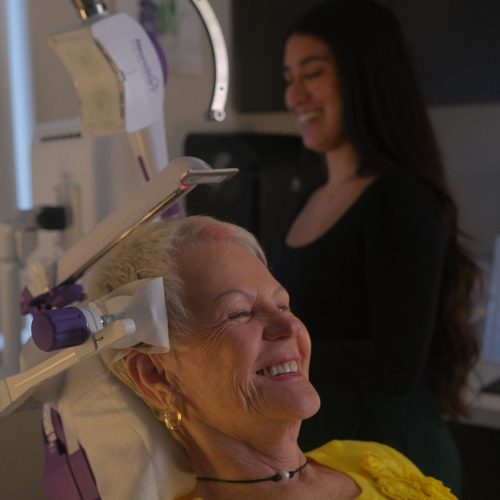
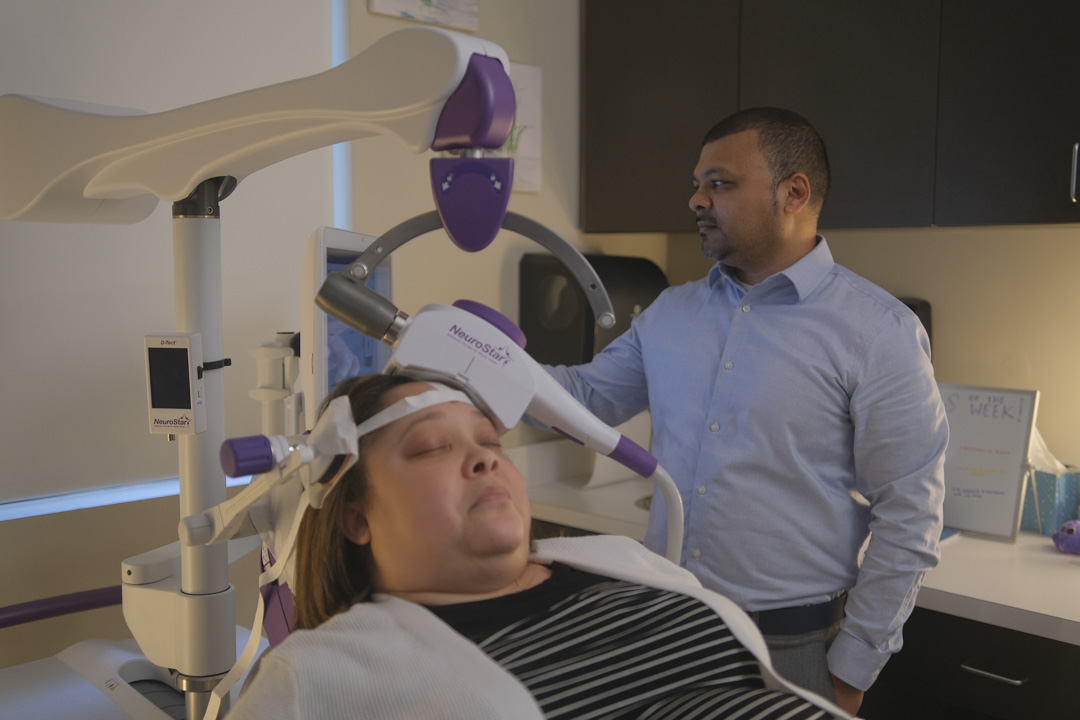
Each session lasts between 18 to 20 minutes and is conducted in private individual treatment rooms within our centers.
We adhere to stringent COVID-19 safety protocols.
20
Minutes
How long does TMS last?
The effects of TMS therapy can last for months or even years after completing a full treatment course. Many patients enjoy long-term relief from depression and anxiety symptoms. In some cases, a “maintenance” session may be recommended if symptoms return, but most people experience a meaningful improvement that lasts well beyond the treatment period.
Is 20 sessions of TMS enough?
For most patients, 20 sessions are not enough to achieve lasting results. A full treatment course usually involves 36 sessions over 7 weeks. Each session builds on the previous one. Consistency trains the brain to create new, healthier patterns. Stopping too early can limit effectiveness, which is why we encourage completing the full course of care for the best outcome.
Take time for yourself
Read, play on your phone, watch TV, meditate.
Neuro Star in Orlando, FL
Specific Nerve Targeting
We guide magnetic pulses precisely to the left prefrontal cortex, the area most linked to mood. Only the areas that matter are stimulated.
Brain Pattern Alteration
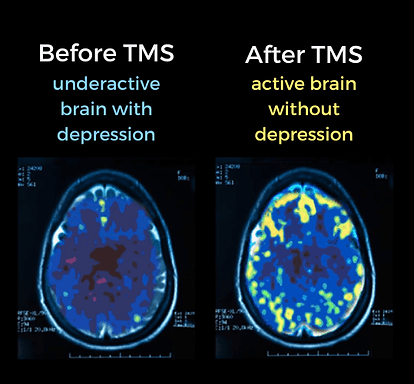
With each session, TMS encourages new neural connections. Patients often describe feeling lighter, more energized, and more like themselves again.
At OneMed in Lake Nona, this isn’t a one-size-fits-all treatment. Our psychiatrists build your NeuroStar therapy around your history, your symptoms, and your life, because lasting relief requires more than a device. It requires a team that knows you.
Transcranial Magnetic Stimulation For Depression
TMS near Lake Nona, FL
Depression is more than feeling sad; it’s a medical condition that can drain your energy, affect your sleep, and make daily life feel overwhelming. For many people, medications or talk therapy bring relief. But when these treatments aren’t enough, Transcranial Magnetic Stimulation (TMS) offers a safe, proven alternative.
Curious About TMS Treatment for Depression?
We can help you find the best treatment tailored to your needs. Let’s talk.

TMS is different from medications and talk therapy. Medications aren’t as customizable — they may not work for genetic reasons and could cause moderate to severe side effects.
Symptoms of depression can also interfere with the comfort and effectiveness of talk therapy.
TMS targets the area of the brain that is believed to regulate mood to treat depression at its neurological source.
TMS does not hurt. You may have a mild headache during the first week which will subside. This can be addressed with as needed Advil. It feels like a tapping sensation on your head.
Each patient is different and some respond within the first few treatments and others need to complete the entire 36. The standard approach is to complete the full series – 36 sessions for it address your symptoms. How do you know it is working ? You will begin to feel happy, motivated, improved energy levels, sleep better, improved libido, and more importantly you will feel like you’re living your life to its fullest potential.
The first step to beginning treating a patient is to ensure that the first day is done precisely. This is known as the mapping day which is the key to success for the other 35 sessions to be purposeful. Our team invests that time up front to make sure day 1 is as close to perfect as we can achieve and we do so using the advanced technology of the neurostar machine and the experience of our physicians. Once we know your mapping settings on day 1 we replicate it each time for your treatment sessions.
While patients do find remission from undergoing TMS therapy the decision to stop medications is done on a case by case basis. It is done with careful supervision and involvement of you, the patient, and psychiatrist. Some medications can’t be abruptly stopped so they may need to be tapered off.
Optimistically, we wish for all our treated patients to live their life in remission. If however your depression does come back, we can always pursue another round of TMS. It is not unheard of for patients to come back in the distant future to repeat the treatment. This is sometimes referred to as maintenance TMS.
No. While TMS is safe and has minimal side effects, ECT requires general anesthesia which can carry some risk.
To date, there is no evidence that TMS causes any kind of long-term damage to the brain. TMS does carry a very minor risk or seizure during treatment, specifically less than 0.1%. This risk seems to be more associated with those who are already at risk of seizure, whether due to a medication, a chronic condition such as epilepsy, or secondary to drug and alcohol use.

Does TMS actually work?
For some patients, the improvements from TMS can be long-lasting, even years after treatment. While depression can return over time, many people maintain their results without the need for daily medication. In cases where symptoms come back, “maintenance” sessions may help keep results steady.
The benefits of TMS often last 6 months to a year or more after a full course of therapy. Everyone responds differently, but many patients enjoy long-term relief. If symptoms return, additional booster sessions can extend the benefits.
Harvard Health reports that 50% to 60% of patients with treatment-resistant depression see a meaningful response from TMS, and roughly one-third achieve full remission.
Varying by protocol:
- Repetitive TMS (rTMS): Around 50% respond, with over 30% achieving remission. Cognitive FX+1
- Deep TMS (dTMS): Higher efficacy—82% response rate and 65% remission after 30 sessions. Even at 20 sessions, 74% response, 58% remission. Cognitive FX+1
Real-world data (UCLA study, 2023): Shows 54% of patients exhibit a clinical response (defined as ≥ 50% improvement).UCLA Health
TMS is still gaining awareness outside of medical circles. While it has been FDA-approved since 2008 and used in millions of treatments, many people simply haven’t heard of it. Some assume it’s similar to ECT (electroconvulsive therapy), but it’s very different. TMS is non-invasive, drug-free, and does not require anesthesia or cause memory loss. At OneMed, part of our mission is to educate the Orlando community about this safe and effective option.
TMS Therapy Cost FAQ’s
Yes, for many patients, TMS is worth the investment. When you compare the cost and side effects of long-term medication use, such as weight gain, sexual side effects, sleep problems, or fatigue, TMS offers a drug-free treatment option with lasting results.
Many patients experience relief that lasts for months or even years, making TMS a cost-effective choice over time. And for many, the improvement in quality of life is truly priceless.
In Orlando, the cost of a single TMS session typically ranges from $250 to $400, depending on the provider and insurance coverage. At OneMed Clinic in Lake Nona, most of our patients use insurance, which significantly lowers or eliminates out-of-pocket expenses. Before starting treatment, our team verifies your benefits and gives you a clear breakdown of costs so there are no surprises.
Without insurance, a full course of TMS therapy in Florida (about 36 sessions) can cost between $6,000 and $12,000. The good news is that most major insurance providers, including Medicare, now cover TMS for treatment-resistant depression. At OneMed, we manage the insurance process for you and help patients maximize coverage so they can focus on getting better, not on the bills.
OneMed TMS Care Team
TMS Near Orlando, FL
Ready to take control of your health?
TMS Near Me
TMS Therapy near Lake Nona, Orlando, FL
-
OneMed Clinic of Lake Nona
10129 Clear Vista St, Orlando, FL 32832
-
admin@onemed.clinic
Hours
Monday | 9AM – 5PM
Thursday | 9AM – 5PM
Wenesday | 9AM – 5PM
Thursday | 9AM – 5PM
Friday | 9AM – 5PM
Saturday | Closed
Sunday | Closed